Too Many Anniversaries of Sacrifice
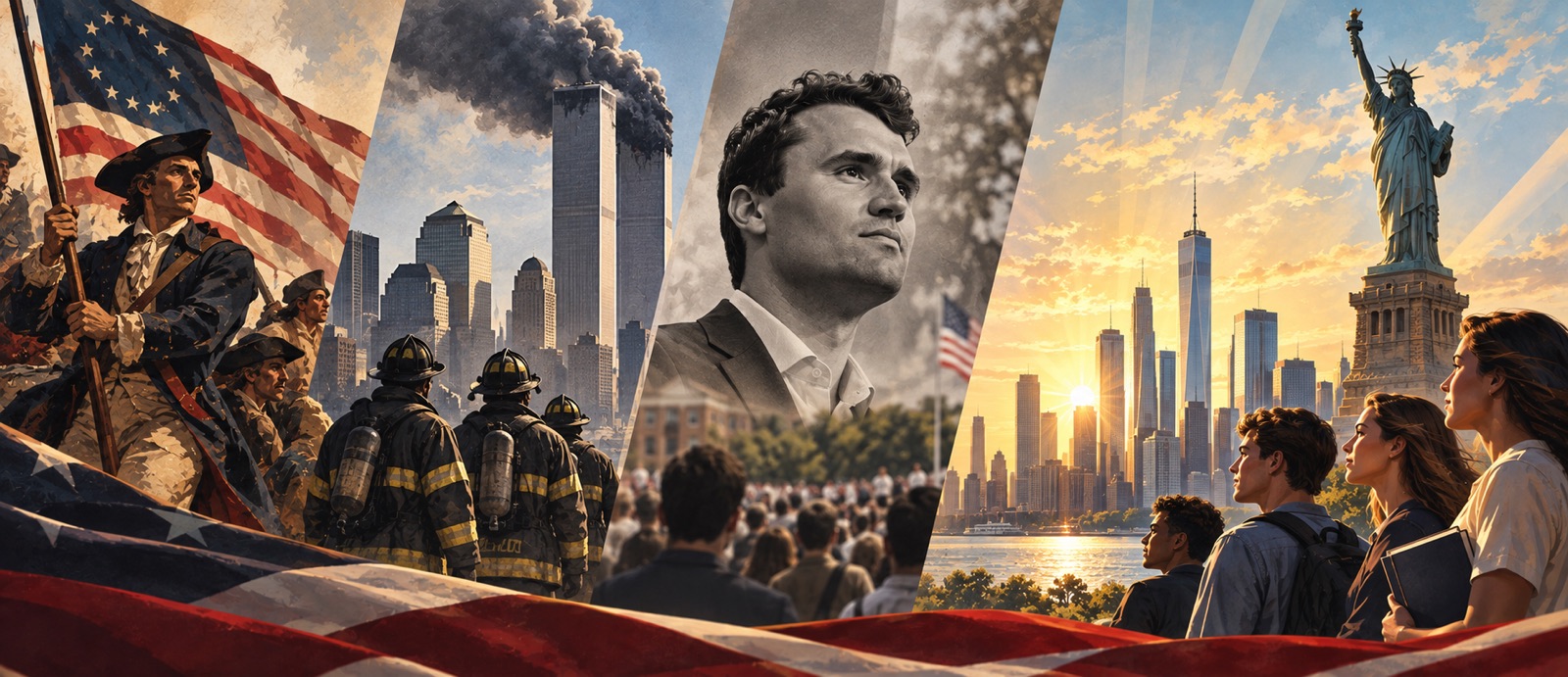
This morning America marks a date that should not blur into a mere calendar entry. Today is the twenty-fifth anniversary of September 11, 2001. Yesterday was the first anniversary of the assassination of Charlie Kirk, shot on September 10, 2025, while taking questions on a public campus in Orem, Utah. Both arrive in the 250th year of the American founding. The methods and the scale were different. The moral error was the same: treating other human beings as objects to be broken rather than as minds to be persuaded. And the debt they right impose on us is the same. People have died, again and again, so that this country might remain a civilization based on liberty, reason, and respect.
This is not seasonal - simply for the summers of sunshine and peace. It becomes sharper when violence is used as an argument. These two anniversaries, arriving in the same week of a year-long celebration of America’s 250th, ask us to remember what the American experiment actually is: a civilization organized around principles of liberty, individual rights, and justice. That experiment is not inherited for free. Patriots paid for it two and a half centuries ago. And, unfortunately, they continue to pay for it today.
They pledged their lives, their fortunes, and their sacred honor
In 1776 the signers of the Declaration of Independence closed with a sentence that was not rhetoric. They pledged to each other their lives, their fortunes, and their sacred honor. Many of them meant it in the most literal way. Farmers left fields. Merchants left ledgers. Teenagers froze at Valley Forge. Men died in mud at Trenton, Saratoga, and Yorktown so that a people might try something the world had rarely allowed: a government that exists to secure rights, not to confer them, and a society in which free persons may speak, worship, own, trade, and associate without asking a king.
That was the first American sacrifice for first principles. It was not a sacrifice for a party. It was a sacrifice for a proposition: that legitimate power rests on the consent of the governed, and that the individual is not the property of the state, the mob, or the assassin. The Revolution was a war of defense against a distant sovereign. It was not a license for later generations to treat violence as a shortcut to the society they prefer. The founders risked the gallows so that persuasion, law, and voluntary exchange could replace arbitrary rule.
Two hundred and fifty years later we are still living on that credit. Every peaceful contract signed in an American office, every uncensored argument on a campus lawn, every company that finds a customer without a commissar is a dividend paid by people who would never meet us. Many have sacrificed. Many have been sacrificed. The only honorable interest on that debt is to carry the principles forward in everything we do.
The towers were not only buildings
Twenty-five years ago this morning, nineteen men flew commercial airliners into the World Trade Center, the Pentagon, and a field in Pennsylvania. Nearly three thousand people were murdered. Firefighters ran up stairwells. Passengers on Flight 93 fought back. Ordinary workers in ordinary offices became, in a single hour, the front line of a republic.
It is right to remember the dead by name. It is also right to remember what the attackers chose as a target. The World Trade Center was not a barracks. It was a marketplace of markets—a dense, vertical city of contracts, shipping, insurance, finance, law, and trade. It stood for the idea that strangers can cooperate across oceans without a commissar assigning them their stations. To strike those towers was to strike America. It was also to strike the visible architecture of capitalism: the belief that wealth is created by production and exchange, not seized by the sword.
Al-Qaeda did not hate America only for its military reach. It hated a civilization in which women work, dissent is printed, capital moves, and no caliph gets to veto a trade. The towers were a symbol of that civilization. So were the people inside them: accountants, traders, cooks, secretaries, window washers, analysts. Capitalism is not a skyline. It is those people, left free to associate.
A microphone is also a target
Yesterday marked one year since Charlie Kirk was killed while doing the least violent thing a public person can do: standing in the open air and answering questions. He was 31, a father, the co-founder of Turning Point USA, and a polarizing figure in American politics. Polarization is not a license. The shot that ended his life was an attempt to settle an argument by ending the arguer.
Whatever one thought of Kirk’s program, the method of his murder was a confession. It said that some views are too dangerous to be heard, and that the proper reply to a campus debate is a rifle from a rooftop. That is not politics. It is the abandonment of politics. A free country does not require us to admire every speaker. It does require us to refuse the premise that disagreement is a capital offense.
Assassinating a man for his speech is an attempt to silence not only him, but everyone who might have spoken next. Fear is the intended product. The secondary product is a public that learns, slowly, to treat ideas as weapons and opponents as targets. That lesson is incompatible with a commercial republic.
Violence is not a strategy of social change
There is a bright line that liberal civilization drew, then forgot how to defend. It is the line between defense and initiation. A free people may use force to stop a murderer, to deter an invasion, to punish a crime after due process. They may not use force to rearrange other people’s minds. The moment “social change” is pursued by breaking bodies, the project has already confessed that it cannot win consent.
This is not a left-right courtesy. It is a first principle. The terrorist who flies a plane into a tower and the assassin who fires on a speaker are not ideological cousins in every doctrine they hold. They are cousins in method. Both treat human beings as means. Both believe that history can be forced. Both are enemies of the only process that has ever produced durable peace: persuasion, contract, and the patient work of building institutions people actually choose.
Business leaders should say this without hedging. Markets cannot function in a culture that romanticizes political violence. Neither can campuses, newsrooms, or legislatures. The rule is simple enough to teach a child and demanding enough to test a nation: do not start it.
Voluntary relationships
Capitalism is often described as an economic system. That is too small. At bottom it is a moral claim about how adults may treat one another. You may offer. You may refuse. You may walk away. You may not put a gun on the table and call the result a deal.
Every payroll, every customer invoice, every partnership agreement is a small act of peace. Two parties decide that cooperation beats isolation. No one is conscripted into the transaction. That is why the shopkeeper and the software founder are not merely “the economy.” They are practitioners of a political philosophy older than any party platform: voluntary association.
The opposite of that philosophy is not always a five-year plan. Sometimes it is a hijacked airliner. Sometimes it is a sniper who decides that a young man with a microphone has forfeited his right to finish a sentence. In both cases the aggressor rejects the premise that other people own their lives.
First principles, in America’s 250th year
2026 is not only the twenty-fifth year after the towers fell. It is the 250th year of the American founding, and of Adam Smith’s Wealth of Nations, published in the same season as the Declaration of Independence. The coincidence is not trivial. Jefferson called Smith’s book the best then extant on political economy. The political claim and the economic claim were twins: individuals come first; governments are instituted to secure rights, not to assign destinies; prosperity grows when people are free to truck, barter, and exchange. Patriots bled for the first claim. Markets, when left free, vindicate the second.
Those are the principles Principled Business has spent the year urging leaders to recover—not as nostalgia, but as operating instructions. Limited government. Property. Speech. Contract. The equality of persons before the law. The right to be left alone and the duty to leave others alone. They are not partisan trophies. They are the conditions under which a diverse people can live together without hunting one another. They are also what a farmer at Concord, a clerk in the North Tower, and a young man with a microphone were, in different centuries, standing inside.
A republic that forgets those conditions will keep producing martyrs and memorials. A republic that remembers them will still argue, often loudly. That is not a defect. Loud argument is what a free country sounds like when it is working. The defect is the man who decides the argument is over and reaches for a weapon.
What we owe them
Remembrance without resolve is sentiment. The patriots of 1776 were not asking later generations for fireworks alone. They were asking that the republic they founded remain a republic of consent. The people who died in the towers, at the Pentagon, and in a Pennsylvania field were living the ordinary miracle of that republic: showing up for work in a commercial nation. Charlie Kirk, whatever one’s view of his politics, was exercising the first freedom on which every other freedom depends: the freedom to speak and to be answered in words.
What we owe them is not a cult of any one man and not a forever war of tribes. We owe them a public ethic older than any of these anniversaries: stand against the initiation of violence as a strategy of social change. Embrace voluntary relationships as the normal way adults coordinate. Return, without embarrassment, to first principles—the ones this country has been celebrating all year, 250 years after it named them, and 250 years after men and women died to make them more than parchment.
Build companies that do not need coercion to find customers. Hire people you do not agree with if they can do the work. Defend the right of your sharpest critics to finish their sentences. Teach the next generation that capitalism is not a conspiracy of the rich but the only large-scale alternative to rule by force. Honor the dead not only by naming them, but by refusing to waste what they purchased.
The founders pledged their lives. The towers fell. A young man with a microphone was silenced. Many have sacrificed, and many have been sacrificed, for the same slender set of principles. We honor them all the same way: by carrying those principles forward in everything we do. The proper reply is not a matching contempt. It is a civilization that still believes persuasion is possible—and that proves it, every day, in the only language a free economy speaks fluently: liberty.